
Anthropic - When saying no to the Pentagon is good for business
When Anthropic refused the Pentagon's demand for unrestricted military use of its AI models in February 2026 - and was promptly designated a "supply chain risk to national security" - it looked like an unusually principled stance for a company at this scale. A $14 billion business telling the US military no, and wearing the consequences.
It is, in fact, a well-trodden pathway in tech. Uber launched illegally in Australia in 2012, accepting criminal charges and regulatory hostility as the cost of building a consumer base large enough to force legislative change. Facebook ignored privacy regulators across multiple jurisdictions for a decade, calculating that a big enough user base would eventually compel governments to accommodate the platform rather than exclude it.
In each case the company sacrificed its regulatory standing (Public Licence) in exchange for stakeholder acceptance (Social Licence) and broader popular support (Popular Licence). The bet was that strength in the second two would either force the first to follow or make it commercially irrelevant. Anthropic was alone among the leading frontier labs in taking the trade.
So is its bet paying off?
The early evidence
In the short term, yes.
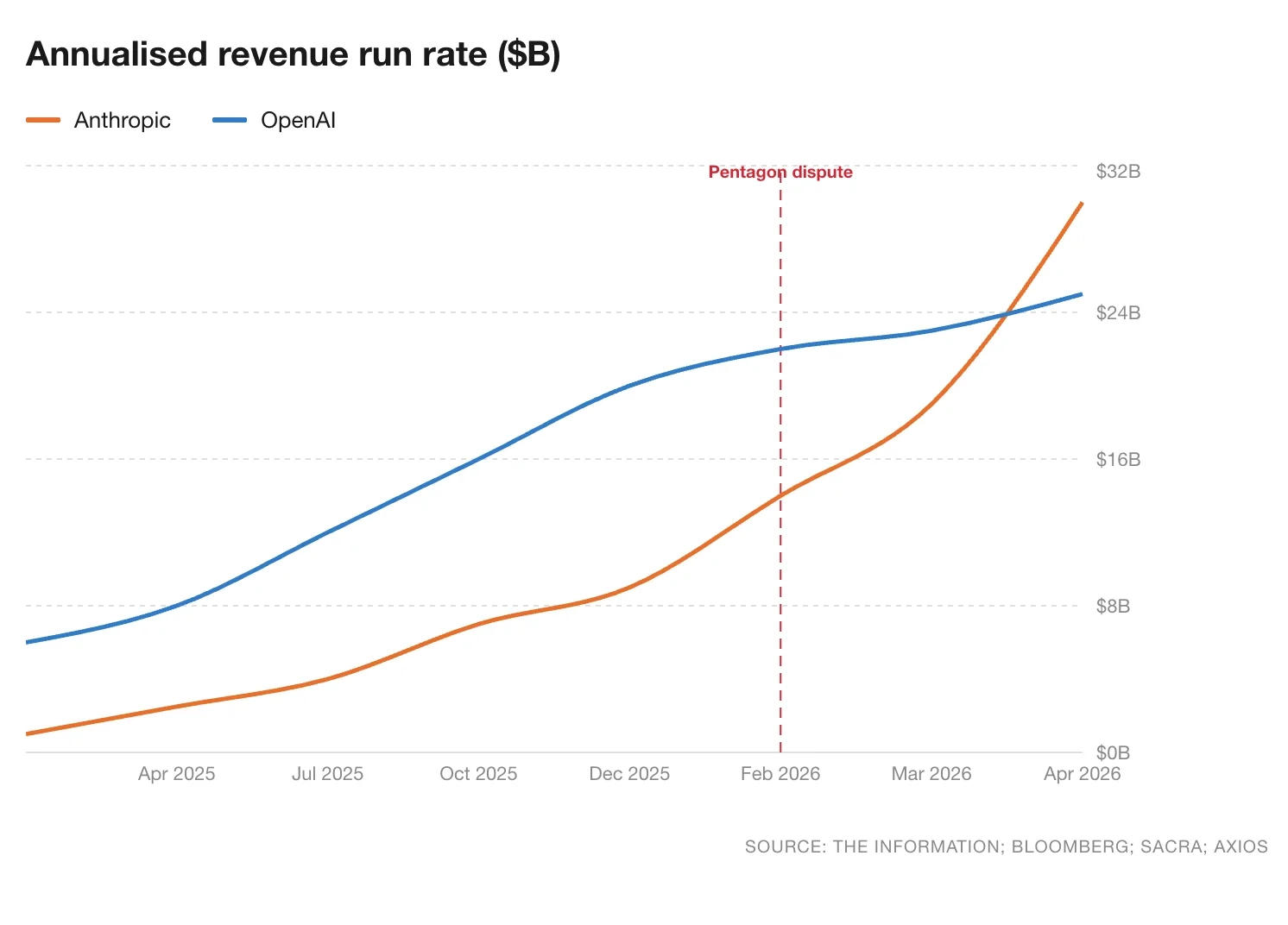
Anthropic's annualised revenue surged from $14 billion to $30 billion in roughly eight weeks, overtaking OpenAI for the first time. Paid subscriptions more than doubled, and the company was adding over one million new users per day globally at the peak of the dispute.
Enterprise adoption showed no sign of slowing after the dispute. According to Ramp, 69 per cent of businesses selecting an AI provider for the first time in March chose Anthropic, up from 59 per cent in February, having already surpassed OpenAI in January. The number of enterprise customers with annualised spending exceeding $1 million doubled from 500 in February 2026 to over 1,000 by early April.
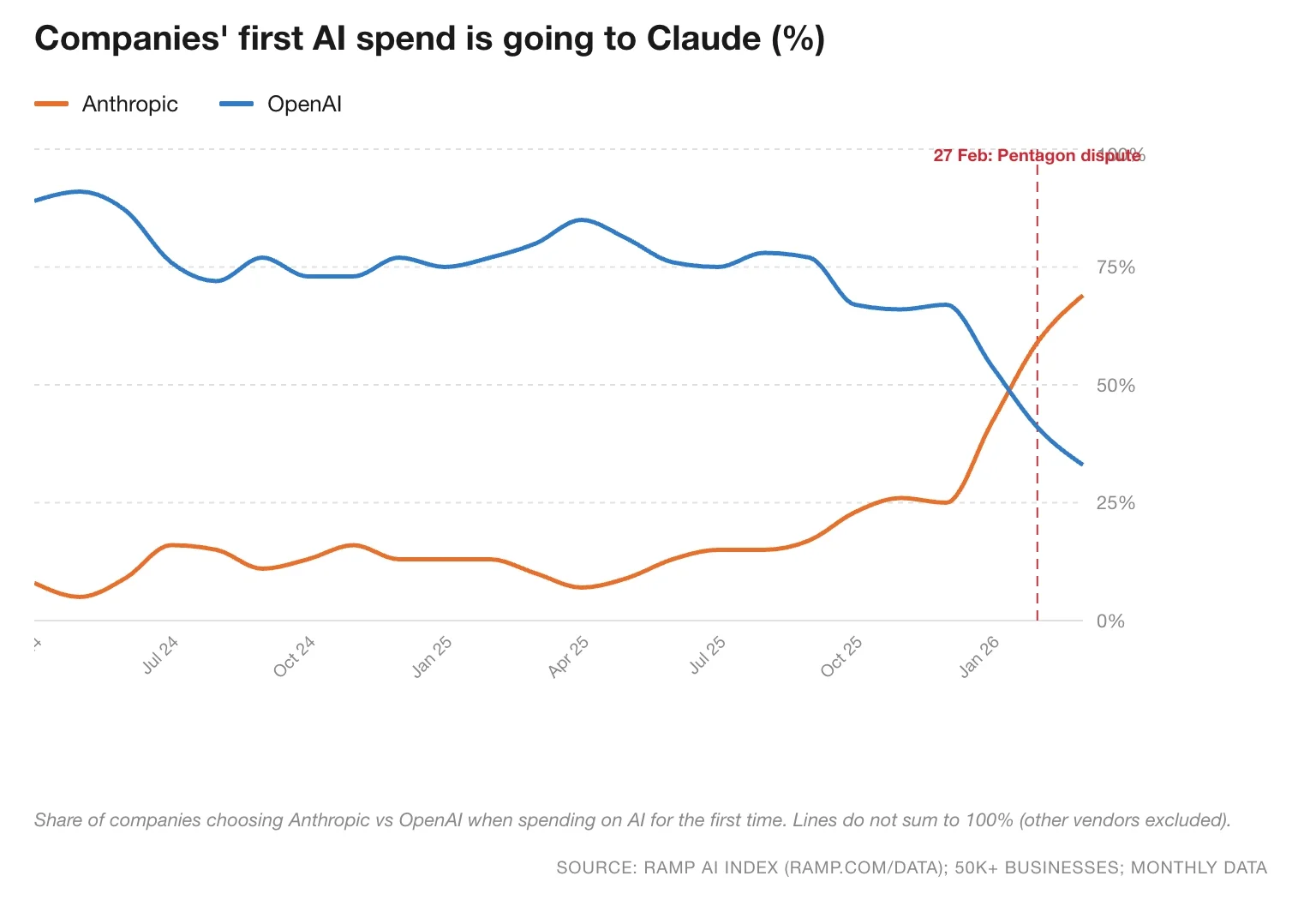
OpenAI's numbers tell the opposite story. Having signed the Pentagon contract hours after Anthropic was blacklisted, it faced a consumer backlash: 2.5 million QuitGPT pledges, a 295 per cent spike in ChatGPT app deletions, and a measurable dip in web traffic.
The counter-case
Anthropic's revenue was already on a steep growth curve before the dispute. The company went from $1 billion to $9 billion in 2025 on the strength of its product alone. Isolating the "Pentagon effect" from organic adoption is difficult, despite the pace of growth.
The Public Licence cost is also real and compounding. Already confirmed is the loss of $200 million in direct DOD contracts and $180 million in enterprise deals that collapsed in the immediate uncertainty. The ripple effect through defence contractors, who are now required to certify they do not use Anthropic's technology, could reach significantly further. Anthropic's CFO told a California federal court in sworn filings that the supply chain risk designation could reduce 2026 revenue by "multiple billions."
Finally, consumer surges are often temporary. The QuitGPT movement's 2.5 million pledges represent fewer than 0.3 per cent of ChatGPT's 900 million weekly active users, and ChatGPT had already regained its lead over Claude in app store rankings by 14 March. Whether the download spike converts into durable paid retention is an open question.
What this means for OpenAI
OpenAI's position is the inverse case study. By accepting the Pentagon's terms it secured government revenue - including a $200 million Pentagon pilot and a federal resume-screening deployment - but exposed its Popular Licence to a values-based attack. Where two dominant providers made opposite choices within hours of each other, the Social Licence gains and losses appear to have transferred directly.
OpenAI is now the company that said yes when Anthropic said no. That reframing, compounded by its move into user-targeted advertising while Anthropic publicly declined to advertise, leaves its brand - founded as a non-profit research lab for AI safety - repositioned. Rebuilding Popular Licence after a values-based reversal is historically harder than rebuilding Public Licence after a regulatory dispute.
The market test
The combined standing a company holds across regulators, stakeholders and the public is its Societal Capital - a currency-like asset that can be built or spent. Anthropic's bet is to bank enough Social and Popular Licence to cover the Public Licence cost.
The Australian government's response offers early evidence for the payoff: while the US withdrew Public Licence, Australia extended it - signing an MOU with Anthropic, committing research funding, and welcoming a Sydney office. Same company, opposite Public Licence outcomes.
Private investors have already rated Anthropic’s bet. In mid-April Bloomberg reported that Anthropic had received unsolicited investor offers valuing the company at roughly $800 billion, more than double the $380 billion post-money it closed in February. Anthropic has so far declined them. On secondary platform Caplight, its valuation has reached $688 billion, up 75 per cent in three months. Bankers are modelling an October IPO that could raise more than $60 billion.
Anthropic's Societal Capital strategy has already bought them a valuation that has doubled in ten weeks, while the US government was trying to damage the business. The bet held.
